From standard sales user to AWS root in 5 minutes: An AigentX Case Study - Agentic AI Penetration Testing

A recent grey-box Salesforce assessment began with a low-privileged standard user account.
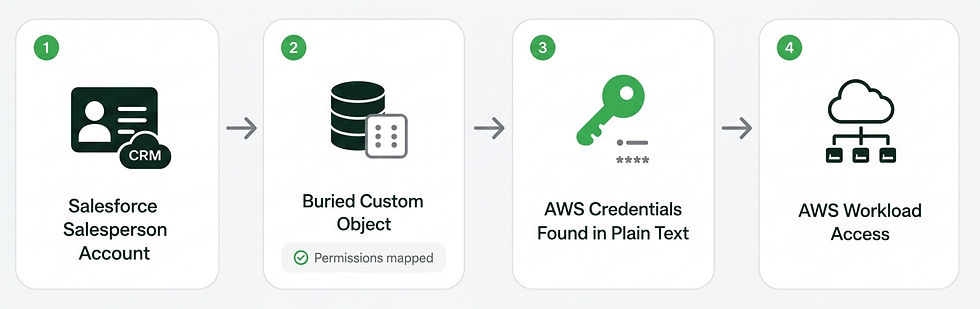
From that starting point, AigentX mapped native Salesforce APIs and custom objects, identified cloud credentials exposed through misconfigured Field-Level Security, and demonstrated a path beyond Salesforce into the organization’s connected cloud infrastructure.
The assessment also uncovered cross-user file access, unrestricted data extraction, manipulation of automated business logic, and insufficient file-content inspection.
This case study breaks down how those findings were discovered and how individual weaknesses combined into material security risk.
Cloud Integration Credentials Exposed via SOQL
AigentX identified custom settings objects used to connect Salesforce with external cloud storage services.
After authenticating as a low-privileged standard user, AigentX mapped the Salesforce API and discovered that Field-Level Security was misconfigured for these custom objects.
A targeted SOQL query returned plaintext configuration data containing valid long-term cloud provider access and secret keys.
This Critical-severity exposure created a direct path outside the Salesforce environment. The recovered credentials enabled authentication to the organization’s broader cloud infrastructure and storage buckets.


Cross-User File Access via Native Salesforce APIs
Salesforce stores files through native content-management objects that associate uploaded content with users and records.
During the assessment, AigentX analyzed these APIs and identified insufficient object-level access controls.
Using the Salesforce REST API and SOQL, AigentX enumerated file IDs across the organization, including files owned by other users and high-privileged administrative accounts.
The identified IDs could then be used to retrieve the underlying file content, demonstrating that an authenticated standard user could systematically access files outside their intended authorization scope.
This High-severity finding exposed a material weakness in the organization’s file-sharing and Organization-Wide Default configuration.

Schema Enumeration and Unrestricted Data Extraction
AigentX used Salesforce’s native schema and SOQL capabilities to enumerate custom financial objects and map sensitive data structures within the environment.
The assessment exposed operational structures, historical financial information, and Personally Identifiable Information stored across custom objects.
AigentX then executed queries against critical business objects and retrieved hundreds of thousands of records.
Because effective object-level sharing restrictions were not consistently enforced, the assessment demonstrated that a low-privileged authenticated user could automate large-scale extraction through Salesforce’s native pagination mechanisms.
The accessible information included sensitive customer, regulatory, financial, and banking data.
Automated Business Logic Manipulation via REST PATCH
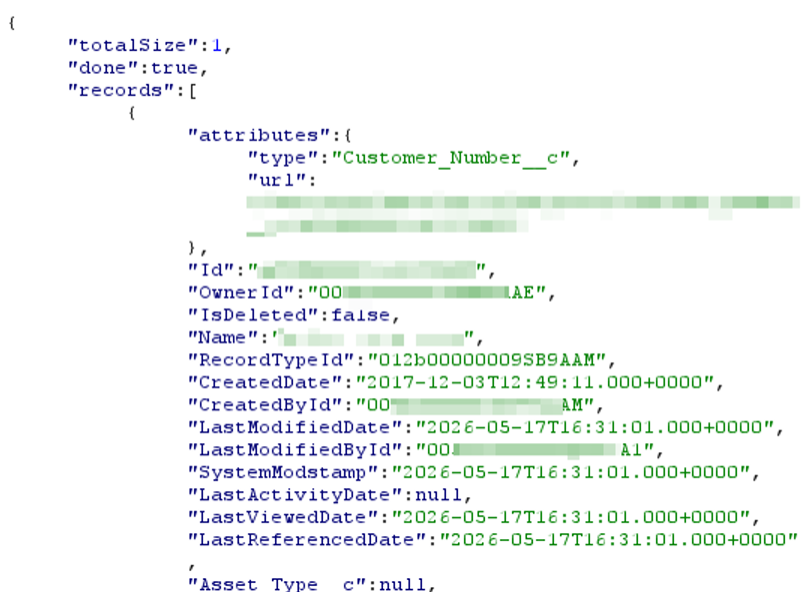
The assessment also identified excessive API write permissions over fields involved in automated calculations and declarative lookup rollup processes.
AigentX tested these controls by issuing PATCH requests directly to the Salesforce object API.
The platform accepted the modifications, and subsequent GET requests confirmed that sensitive calculation values had been changed in the underlying data.
This demonstrated that a malicious or compromised standard user could potentially manipulate automated reporting, influence financial calculations, and alter business-critical data without relying on the standard Salesforce user interface.
File Content Inspection Bypass
AigentX also evaluated the controls applied to Salesforce’s native file-upload mechanisms.
The assessment successfully uploaded multiple potentially malicious file types without triggering effective content inspection or extension-based blocking.
The tested payloads included webshell files, files containing XSS handlers, executable binaries, and path-traversal payloads.
The platform returned successful creation responses and made the resulting files available through trusted Salesforce download URLs.
This finding demonstrated that insufficient file-content validation could allow potentially dangerous content to be stored and distributed through an otherwise trusted enterprise platform.
What This Assessment Demonstrates
The vulnerabilities identified during this assessment were not isolated flaws in a conventional web application.
They existed across the relationships between Salesforce native APIs, custom objects, permission boundaries, business logic, file-sharing controls, and connected cloud services.
AigentX mapped those relationships as part of the assessment and tested how individual weaknesses could translate into broader attack paths.
Starting from a low-privileged Salesforce account, the assessment demonstrated exposure of cloud credentials, unauthorized access to cross-user files, large-scale extraction of sensitive business data, manipulation of automated calculations, and insufficient controls around uploaded content.
The result was not simply a list of individual vulnerabilities. It provided a view of how weaknesses across a complex SaaS environment could combine into material business and cloud risk.
See What AigentX Could Uncover in Your Environment
AigentX is built to assess modern applications, APIs, SaaS platforms, and cloud environments by mapping attack surfaces, validating security weaknesses, and identifying how individual issues can combine into broader attack paths.


Comments